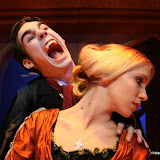
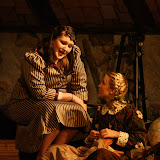
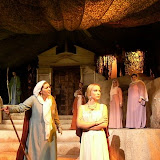
While browsing random costume-related websites I stumbled upon Time's list of the top 10 movie costumes of all time. I found it a pretty interesting waste of 3 minutes so I figured I would share.
http://www.time.com/time/photogallery/0,29307,1699703,00.html
Wednesday, September 17, 2008

Friday, September 12, 2008
Body Painting
Here is a link to the 2008 World Body Painting Day. The make up that looks like animals is amazing! Warning: The models are required to wear underwear but the women may go without tops if they want to.
http://www.pixcetera.com/pixcetera/2008-world-body-painting-day/32599?icid=200100397x1209587962x1200528207
http://www.pixcetera.com/pixcetera/2008-world-body-painting-day/32599?icid=200100397x1209587962x1200528207
Bayeux Tapestry

The Bayeux Tapestry is a documentary record which employs particular narrative techniques and makes use of symbolism. It retains to this day an element of mystery, as several questions have not yet been fully answered. The truly exceptional character of the Tapestry also lies in its size: it is 68.80 metres long, 50 centimetres high and weighs close to 350 kilograms (original cloth and lining).

Nobles feasting. Detail of the Bayeux Tapestry – 11th century; by special permission of the City of Bayeux
Cooks are depicted preparing and serving a banquet on the Bayeux Tapestry. A raiding party returned from the countryside with a cow, sheep or pig. The feast was cooked in the open air, roasted on spits, while a cauldron bubbled over a fire. The food was passed to the servants, who ate the coarser fare on a table assembled from shields. They in turn served their masters who sat at table and dined in some style.

Thursday, September 11, 2008
Little Laugh might do you some good.
This has nothing to do with anything we are doing or learning but this site might be a great pick me up after a long hard day. Just a little Lolz might do you some good.
 Hope that gave you some lolz for now!
Drawing on the Right Side of the Brain
Two Ways of Knowing
Betty Edwards has used the terms L-Mode and R-Mode to designate two ways of knowing and seeing - the verbal, analytic mode and the visual, perceptual mode - no matter where they are located in the individual brain. You are probably aware of these different characteristics. L-mode is a step-by-step style of thinking, using words, numbers and other symbols. L-mode strings things out in sequences, like words in a sentence. R-mode on the other hand, uses visual information and processes, not step-by-step, but all at once, like recognizing the face of a friend.
"You have two brains: a left and a right. Modern brain scientists now know that your left brain is your verbal and rational brain; it thinks serially and reduces its thoughts to numbers, letters and words… Your right brain is your nonverbal and intuitive brain; it thinks in patterns, or pictures, composed of ‘whole things,’ and does not comprehend reductions, either numbers, letters, or words."
From The Fabric of Mind, by the eminent scientist and neurosurgeon, Richard Bergland. Viking Penguin, Inc., New York 1985. pg.1
Most activities require both modes, each contributing its special functions, but a few activities require mainly one mode, without interference from the other. Drawing is one of these activities.
Learning to draw, then, turns out not to be "learning to draw." Paradoxically, "learning to draw" means learning to make a mental shift from L-mode to R-mode. That is what a person trained in drawing does, and that is what you can learn.
If you have not had contact with this book, it may be a good thing to go through. It is a self study, and can easily be done in a week with no school (possibly christmas break?) It will help teach you how to "SEE" things differently, or, rather, correctly.
Betty Edwards has used the terms L-Mode and R-Mode to designate two ways of knowing and seeing - the verbal, analytic mode and the visual, perceptual mode - no matter where they are located in the individual brain. You are probably aware of these different characteristics. L-mode is a step-by-step style of thinking, using words, numbers and other symbols. L-mode strings things out in sequences, like words in a sentence. R-mode on the other hand, uses visual information and processes, not step-by-step, but all at once, like recognizing the face of a friend.
"You have two brains: a left and a right. Modern brain scientists now know that your left brain is your verbal and rational brain; it thinks serially and reduces its thoughts to numbers, letters and words… Your right brain is your nonverbal and intuitive brain; it thinks in patterns, or pictures, composed of ‘whole things,’ and does not comprehend reductions, either numbers, letters, or words."
From The Fabric of Mind, by the eminent scientist and neurosurgeon, Richard Bergland. Viking Penguin, Inc., New York 1985. pg.1
Most activities require both modes, each contributing its special functions, but a few activities require mainly one mode, without interference from the other. Drawing is one of these activities.
Learning to draw, then, turns out not to be "learning to draw." Paradoxically, "learning to draw" means learning to make a mental shift from L-mode to R-mode. That is what a person trained in drawing does, and that is what you can learn.
If you have not had contact with this book, it may be a good thing to go through. It is a self study, and can easily be done in a week with no school (possibly christmas break?) It will help teach you how to "SEE" things differently, or, rather, correctly.
Wednesday, September 10, 2008
A Tutu is Born


The First tutu was worn by Paris Ballet Opera's dancers in 1832 and the first Ballerina to wear a tutu was Marie Taglioni. Which was the "Romantic Tutu" which is cut below the knee and above the ankle. This is to reveal the intricacles of her famous legwork. The "Romantic Tutu" delicate and feminine which allows the dancer to move about freely, as if she was floating through the air. Later came the "Classical Tutu" was born from the viewers request in 1880. Worn by and Italian ballerina Virginia Zucci. There are 4 types of tutu's. Classical Tutu, which is also called "Pancake," Bell Tutu, which looks like a bell and just above the knee, Long Romantic Tutu, which is above the ankles, or mid calf and Short Romantic Tutu, which is above the knee. Since its very first days, the tutu has been the traditional costume and it symbolizes the Ballerina.
Tuesday, September 9, 2008
My summer project
I had to decide on my flowers for my term next year before I came back to school. Here are the pictures of the final and approved design. Fortunately, the S.I. decided she liked my 1st design so much I did not have to go buy more flowers and try again.
edit: I mentioned to my mom that I put up the pictures and she advised me to take them down. Just in case someone accidentally came across this blog. I wasn't thinking. If anyone wants to see the pictures just ask me.
edit: I mentioned to my mom that I put up the pictures and she advised me to take them down. Just in case someone accidentally came across this blog. I wasn't thinking. If anyone wants to see the pictures just ask me.
Tyrian Purple
The fast, non-fading dye was an item of luxury trade, prized by Romans, who used it to colour ceremonial robes. It is believed that the intensity of the purple hue improved, rather than faded, as the dyed cloth aged. Pliny the Elder described the dyeing process of two purples in his Natural History[7]:
“
... the Tyrian hue ... is considered of the best quality when it has exactly the colour of clotted blood, and is of a blackish hue to the sight, but of a shining appearance when held up to the light; hence it is that we find Homer speaking of "purple blood."
”
Archaeological data from Tyre indicate that the snails were collected in large vats and left to decompose. This produced a hideous stench that was actually mentioned by ancient authors. Not much is known about the subsequent steps, and the actual ancient method for mass-producing the two murex dyes has not yet been successfully reconstructed; this special "blackish clotted blood" colour, which was prized above all others, is believed to be achieved by double-dipping the cloth, once in the indigo dye of H. trunculus and once in the purple-red dye of M. brandaris.
-wikipedia
In my opinion wikipedia should be double checked at every turn but, this is very similar to the way the process was explained to me in school and is eaisly checkout on via other sources on the web and in books.
What we went through for purple...amazing.
“
... the Tyrian hue ... is considered of the best quality when it has exactly the colour of clotted blood, and is of a blackish hue to the sight, but of a shining appearance when held up to the light; hence it is that we find Homer speaking of "purple blood."
”
Archaeological data from Tyre indicate that the snails were collected in large vats and left to decompose. This produced a hideous stench that was actually mentioned by ancient authors. Not much is known about the subsequent steps, and the actual ancient method for mass-producing the two murex dyes has not yet been successfully reconstructed; this special "blackish clotted blood" colour, which was prized above all others, is believed to be achieved by double-dipping the cloth, once in the indigo dye of H. trunculus and once in the purple-red dye of M. brandaris.
-wikipedia
In my opinion wikipedia should be double checked at every turn but, this is very similar to the way the process was explained to me in school and is eaisly checkout on via other sources on the web and in books.
What we went through for purple...amazing.
Mood Fabric Store in NYC


 This summer I took a trip to New York City. The number one stop on my list was the Mood fabric store. If your not familiar with it, it's the fabric store they use on Project Runway. The store has three stories filled with aisles and walls full of fabric, buttons, closures and many other findings. I was blown away by the amount of fabric. I could hardly concentrate when trying to find fabric to buy. If you ever have a chance to go to NYC and is interested in the fashion world, Mood is a great place to check out!
Monday, September 8, 2008
fun facts!!!! about gem stones

in the early centuries, precious stones were said to have powers that could relieve illness and other uses.


Christian Louboutin Gold Spiked ShowSTOPPERS
These Shoes will definately command everyone's attention!
Also they are great for self defence, just one kick you know where, and they'll part like the red sea!

Also they are great for self defence, just one kick you know where, and they'll part like the red sea!

Donna Karan Heels
The Donna Karan 'Michelle' D'Orsay heels are something special. They may be $778, but just imagine how many conversations would begin with "Wow, you're shoes are really something..." if you wore these to a party with your LBD. They combine gold metallic leather and hot pink (sorry, 'bouganvillea') suede with a stacked stiletto heel and scalloped edges. What's not to love? They also come in black and gold if pink's not your thing.

Sunday, September 7, 2008
What to do to be called a Haute Couture Designer

A common misnomer, Haute Couture is not some casual reference that can be thrown on any pret-a-porter (ready to wear) item simply because you will it to be so, nor do clothes or shoes become Haute Couture when they travel down the cat. The term is actually legally protected in France, by the Chambre de commerce et d’industrie de Paris. Each year the prestigious list is drawn with the names of the chosen companies that are allowed to consider themselves as Haute Couture or to use the term in any reference whatsoever! According to the rules, to become a house of Haute Couture you must design made to order fashions for private clients with one or more fittings, have a workshop in Paris with at least 15 employees, and each season are required to present a collection to the Paris press consisting of a minimum of 35 runs with both day and evening wear! I can imagine it! The atelier elders stand after days of serious deliberation, all proper considerations met, and the fragile gold encrusted scroll is opened as the house names are called out as if being knighted! If that doesn’t titillate you, then, well you’re dead!
Subscribe to:
Posts (Atom)